
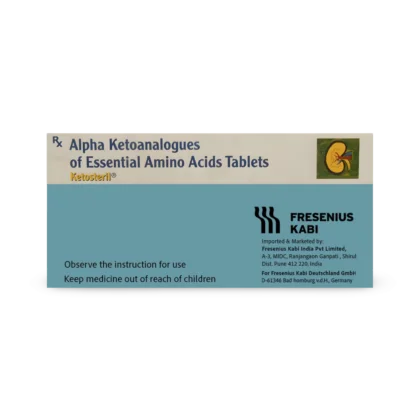
Ketosteril Tablet
Provides essential nitrogen-free amino acid precursors to support protein metabolism and reduce buildup of waste products.
Amino acids are the building blocks of proteins, playing a fundamental role in nearly every biological process. They are essential for muscle repair, hormone production, and maintaining metabolic stability. One formulation is listed below, providing a focused approach to managing nutritional needs where dietary intake alone may not be sufficient for recovery.
Provides essential nitrogen-free amino acid precursors to support protein metabolism and reduce buildup of waste products.
Amino acids are organic compounds that link together to create the proteins your body requires to function. While your system can produce some on its own, others—known as essential amino acids—must come directly from your diet or specific supplementation. When you introduce these compounds, you are providing your cells with the raw materials needed for ongoing physical maintenance.
Because different health conditions can affect how your body breaks down and utilizes protein, various preparations exist to address specific metabolic requirements. Some versions focus on branched-chain varieties often used in sports recovery, while others provide specialized combinations intended to support kidney health or metabolic efficiency. Understanding your unique nutritional requirement is the starting point for choosing the right approach.
The regulatory status of amino acid preparations depends heavily on their intended use and concentration. Across global markets, including the United States, United Kingdom, Australia, and Canada, these compounds are primarily categorized as dietary supplements or nutritional products. Because they are often derived from natural protein sources, they typically do not face the same stringent oversight as synthetic pharmaceutical agents.
However, specific concentrated formulations designed for therapeutic use in managing conditions like chronic kidney disease may fall under stricter pharmacy regulation. In these cases, your healthcare provider acts as the final authority on whether a specific formulation aligns with your existing health plan. If you are comparing different products, check the labeling for standardized ingredient purity to ensure the preparation meets your expectations for quality.
These supplements are widely used to support muscle protein synthesis and promote recovery after periods of high physical stress. By providing a ready-to-use supply of foundational building blocks, they assist your body in repairing tissues and maintaining lean muscle mass. This is particularly relevant for individuals managing restricted diets or those whose metabolic condition makes it difficult to process whole-food proteins effectively.
Beyond physical recovery, certain amino acid profiles serve to address imbalances in metabolic pathways. They act as precursors for neurotransmitters, which can influence mood, sleep, and overall energy levels. Using these preparations effectively often means focusing on the specific ratio of essential compounds that addresses your personal nutritional gaps.
When you take an amino acid supplement, you are bypassing the initial digestive work required to break down complex dietary proteins. Your bloodstream absorbs these free-form compounds rapidly, delivering them directly to tissues or organs that need immediate metabolic support. This direct delivery encourages your system to initiate protein synthesis—the process of creating new proteins—more efficiently than relying on standard digestion alone.
By maintaining a consistent internal environment of these building blocks, you help stabilize your body’s nitrogen balance. A balanced nitrogen state is key to preventing muscle wasting and ensuring that your organ systems have the resources necessary for daily repair cycles. This metabolic stability is what contributes to the sustained support many experience during periods of intense recovery or nutritional restriction.
The world of amino acids is split into two major categories: essential and non-essential. Essential amino acids cannot be manufactured by your body, meaning they must be introduced externally. Non-essential variants, while still important, can be produced internally, provided your system has enough of the essential foundation to work with.
Most supplement preparations are designed to fill the specific gaps that occur when your natural intake falls short. Whether you are using them to boost athletic performance or manage a specific medical condition, these supplements function as a bridge for your metabolic pathways. This is why you will often see them labeled by their specific ratio of BCAAs—branched-chain amino acids—or as part of a comprehensive supportive blend.
Before adding amino acid supplements to your routine, evaluate your current kidney and liver health, as these organs are responsible for processing protein metabolites. If you have pre-existing metabolic disorders, speak with a professional to ensure the supplement does not interfere with your body’s ability to clear specific by-products. Always check the ingredient list for fillers or additional compounds that may be inappropriate for your specific health requirements.
Most people tolerate these supplements well, though high doses may lead to minor digestive discomfort such as bloating or nausea. Because amino acids influence neurotransmitter production, some individuals may notice shifts in energy or mood when starting a new preparation. If you experience unexpected physical changes after beginning a course, pause your intake and review the ingredient composition for potential sensitivities.
Amino acid supplements can interact with certain medications, particularly those that affect kidney function or blood pressure. If you are currently taking prescription drugs, confirm with a provider that your supplement won’t alter the metabolism or absorption of your existing medical regimen. Product labeling and verified clinical sources remain the correct references for specific contraindications, interactions, and potential reactions.
This information serves as an educational overview of amino acids and is not medical advice. Individual products containing these ingredients may differ significantly in formulation, strength, and suggested frequency of use. This page does not authorize clinical application, self-directed interpretation, or unsupervised use of dietary supplements. Always review specific product labeling and speak with a healthcare professional when your clinical situation requires a personalized judgment or medical oversight.